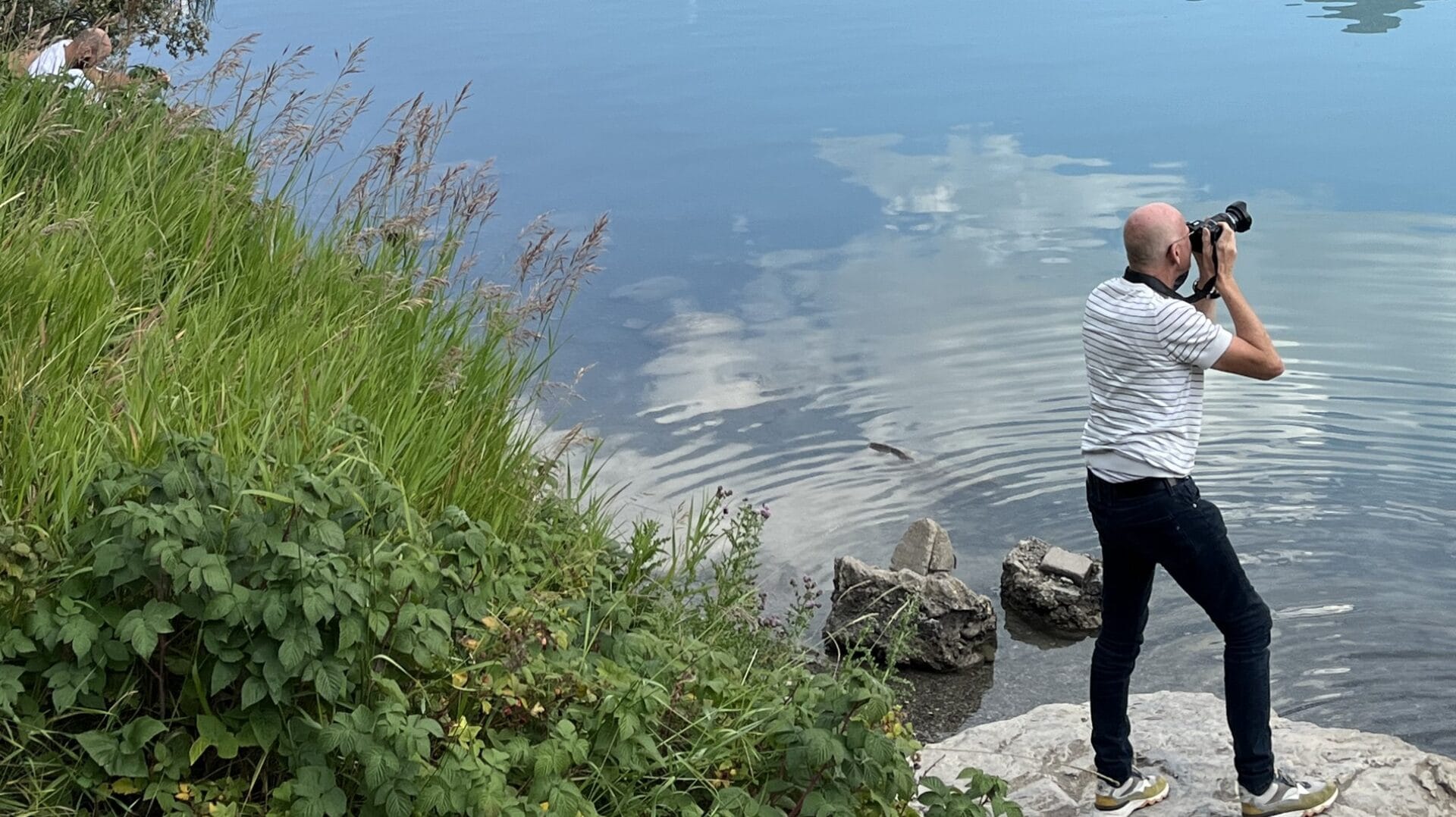
To get an idea of the range of the “Big White”, I’ve taken following shots during my trip to Murchison Falls National Park in Uganda.
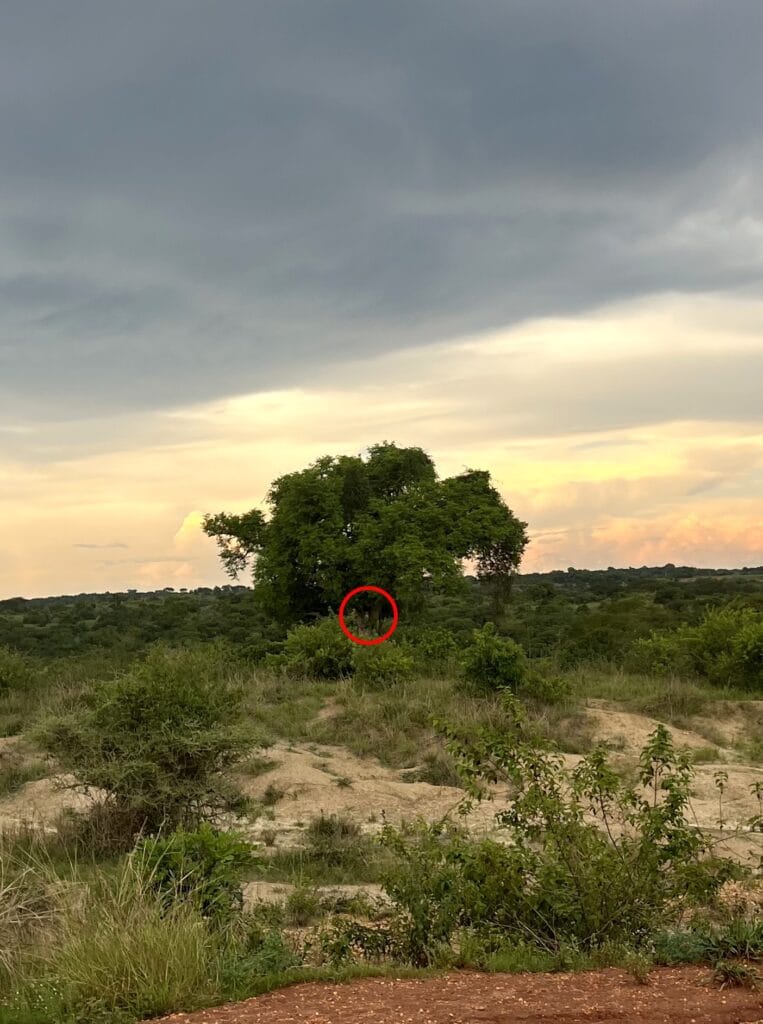
The image above is taken with an iPhone, “zoom” at 1x. In that red circle sits a leopard. In the Murchison Falls National Park, it is strictly prohibited to leave the path, one risks very high fines when one does it and there are rangers all over the place (on motorcycles and in jeeps). So, we couldn’t get any closer than this position. Now check out the next couple of images taken with the Big White (I have named that lens “Alma”, check this link if you want to know why).
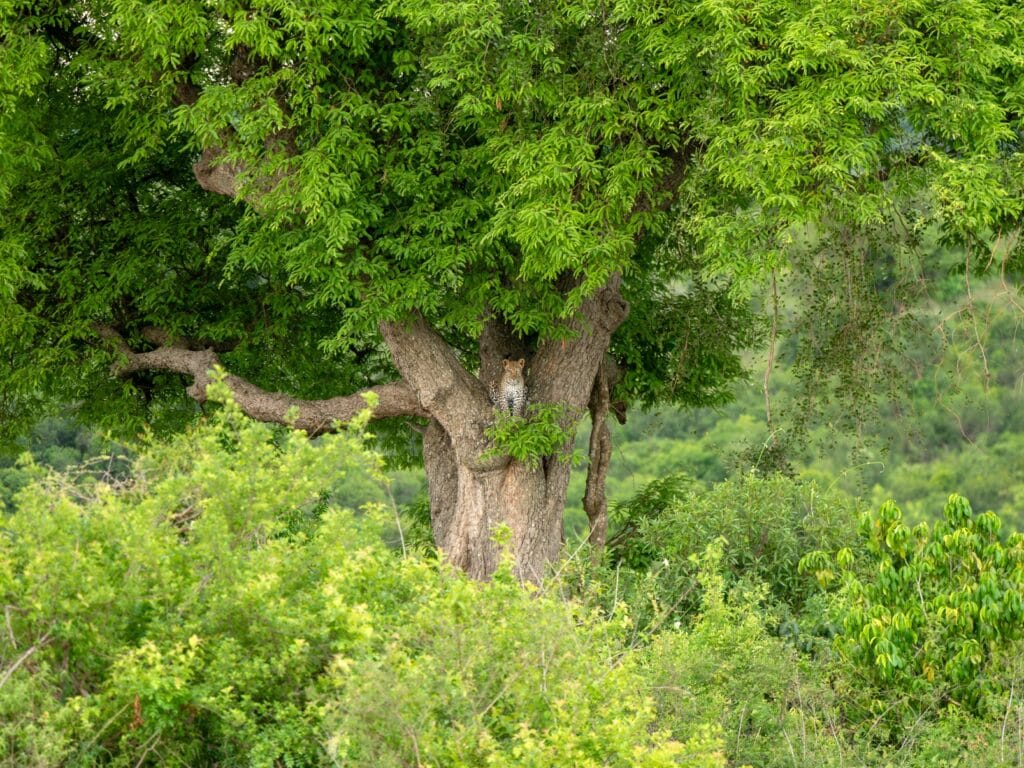
The shot above is taken at a MFT focal length of 178mm, that translates to a Full Frame Focal length of 356mm, hand held, thanks to the Sync IS system, this synchronizes the Image Stabilization of the camera body with the Image Stabilization of the lens.

The shot above was taken at 400mm focal length, that is the far long end of the lens, again, Hand Held. To get an idea what that is in Full Frame terms, you multiply that by 2, so you’ll get 800mm. For the photography nerds amongst us, yes, to get an idea what Depth of Field does, one has to multiply that by 2 as well, that shot above was taken with the lens wide open, so at f/4.5, translated to FF terms, a DoF of 9, which gets the cat sharp + most of the tree and nicely blurs out the foliage on the background. Had this shot been taken with a Full Frame lens at an aperture of f/4.5, the blurring would start probably right behind the cat, so the rear bit of the trunk would have been out of focus. Some people appreciate this “isolating the subject”, to them that is a genuine plus for shooting with Full Frame gear. They would have to carry a bulkier lens though to get a similar framing (but as Full Frame bodies generally have sensors with more pixels than 20MP, one would not necessarily need a 800mm range). To get the same Depth of Field, on the Full Frame gear with that 600-700mm lens (depending on the pixel count of the sensor), one could obviously squeeze the aperture to f/9.0.

Now, Alma has an internal Teleconverter, it is operated by a switch, for the shot above, I flipped that switch and did a bit of Post Production cropping, most of the images on my website have been cropped to 1600x1200mm (to prevent folk from downloading the full 20MP MFT images or the 60MP Sony FF images and use them for whatever reason I would not be aware of), I’ll make an exemption with the crop image of the leopard, it is cropped to 1843×2840 pixels. This means it could be printed at a maximum size of Europe standard A4, but one would do best by applying a “passe partout” around it, so the image would be larger than A5 (148x210mm), but smaller than the full A4 size (210x297mm).
Yep, is could be a tad sharper. In my gear, I carried an additional teleconverter, a 1.4x one. This was my first Safari trip with Alma and, as I had not had enough time to experiment how Alma would perform with a 1.4x TC on (in terms of sharpness), I did not have it on when we spotted that leopard. Obviously, as soon as I had that MC14 TC mounted, the cat was gone. Meanwhile I have learned that image quality does not really noticeably suffer from having that MC14 on, just as long as you are not shooting in dusk or dawn light conditions. Ever since, I have the MC14 on by default because I rarely find 210mm too long (because I also have an OM-1.1 with a 40-150mm f/2.8 Pro ready at hand), the gap of 60mm between both cameras and their lenses that is created by that 1.4x converter has not ever hurt me, missing the extra 200mm has on a few occasions, amongst them, this cat. Again, for photography nerds, all my wildlife shots are taken hand held. Precisely the reason why I decided to stick to the Micro Four Thirds format for wildlife photography: I want reach but not at the cost of weight and bulky equipment that require me to drag along a monopod or tripod. Yes, it does mean a compromise in Image Quality, but not that one can see that in a print up to A3 size (or even A2 size, as is demonstrated in this video). If you wish to see more about this before I get to post Side-By-Side comparison shots, check out this video (that said, in the video the latest 50-200mm f/2.8 IS Pro is set up next to a 200-600mm FF lens, I think that is not quite as close as a comparison as “my” Alma against that 200-600mm FF, yes, theoretically, the reach of Alma is up to 1000mm in FF terms, so a whopping 400mm further than the 200-600mm Sigma FF lens, but one can reduce that big difference in post production as the FF sensor is bigger and holds more pixels, in my gear set-up: 20MP OM-1 vs 60MP Sony A7R IV).
It is my ambition to expand this website up to reviews of equipment, how I operate in the field and why I chose what equipment for certain shots. And do in depth side-by-side comparison with my FF and MFT cameras (if one is new to digital photography, whole battles are fought out on various platforms between fans of the MFT format and the FF format, after having read thousands of postings on numerous fora AND having the luxury of having both systems at my disposal, in my opinion it boils down to this: FF offers less noise in lower light, better chance of nice bokeh depending on lens choice, better Dynamic Range and more post production crop options. MFT offers better portability, more in camera fancy computational photography options, including digital NG filters, faster burst rates and close to insane image stabilization).
I tend to pick the best suited camera for the image I plan to take, simply because I can. I would have a very difficult time if I were to chose between those two formats, so, I won’t spend any energy there. If you stumbled over my website Googling “MFT vs FF” and hope to find The Holy Grail in getting a solid decision advice what system to go for if you plan to invest in only 1 body, I’m afraid that I will have to disappoint you. Remember, not only did I decide to have two formats, I also decided to have 3 camera bodies…. If someone would put a gun to my head and made me decide…. OK, the OM System would win. I would miss my nice Sony though. All I got to do is hope that nobody plans to put that gun against my skull and force me to let go of it.

The shot above was taken with the 1.25TC flipped, but not at the end of the range, resulting in a focal length of 459mm. To get an idea of the sharpness of the lens, below a so called “100% crop” screenshot of the image above, centered on the head of the bird:
